
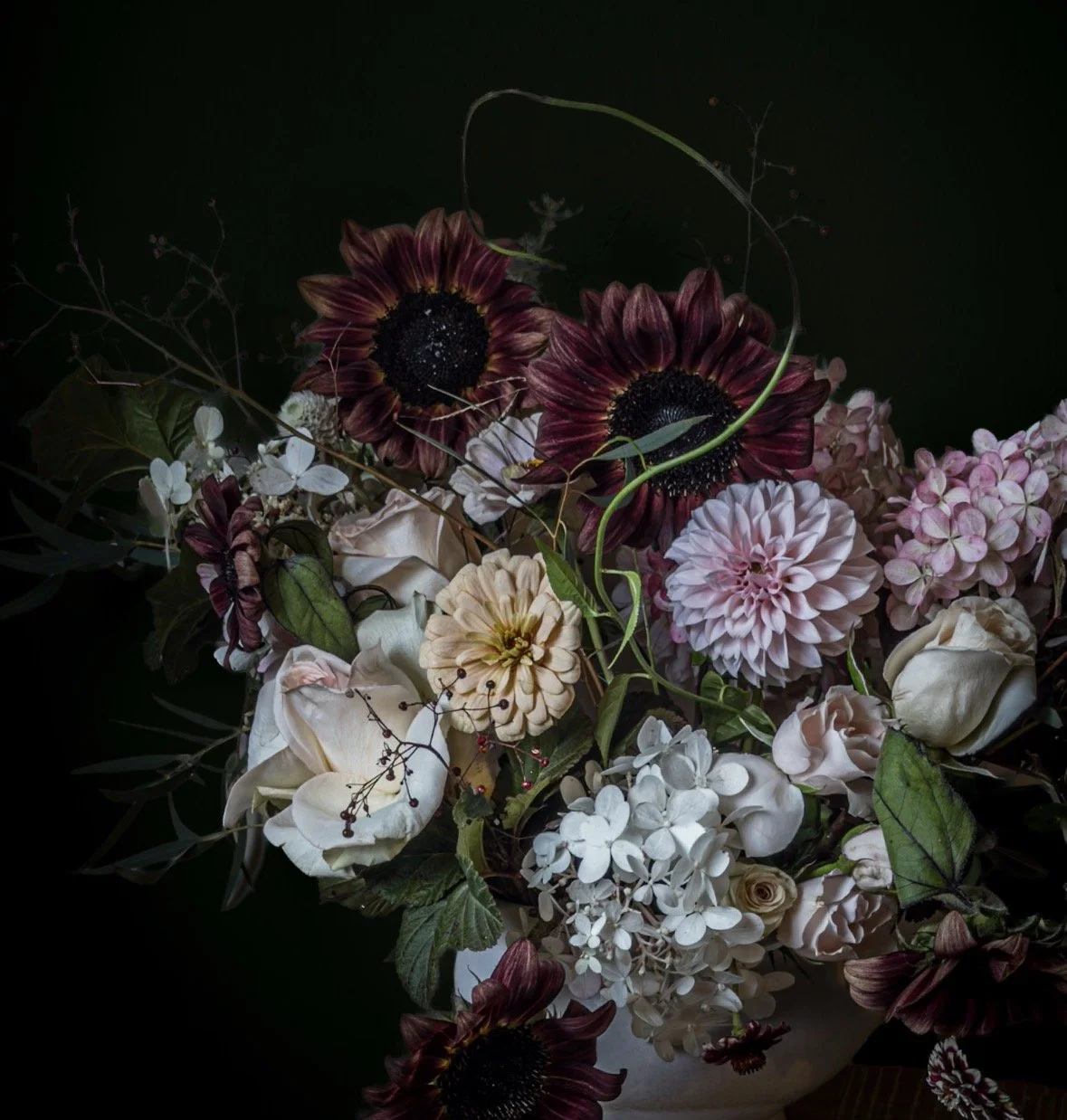
Real wedding flower costs, budgeting mistakes worth avoiding, and advice from a floral designer on getting the wedding you actually want.
The average cost of wedding flowers in the United States is $2,800, according to The Knot's 2026 wedding cost reporting, based on couples married in 2025.
But that number comes with a pretty big catch.
If your Pinterest board is filled with minimal, sophisticated floral designs, that beautiful modern-vintage aesthetic, or flowers that seem to belong in a fashion editorial, the national average doesn't tell you what it will take to achieve that look.
And here's something even more important.
Two couples can spend the exact same amount on wedding flowers, use similar materials, and end up with completely different results.
Why?
Because beautiful flowers don't automatically create beautiful floral design.
The person designing them needs to understand the aesthetic you're drawn to. The shapes, the proportions, the movement, the colors, and how everything works together.
A designer can be talented, experienced, and genuinely passionate about their work, but that doesn't mean they specialize in the particular style you love.
And that's where some of the most expensive wedding flower mistakes begin.
Before you start booking florists or eliminating things from your floral budget, I want to share a few things I wish every couple understood.
Because the goal isn't simply to figure out how much wedding flowers cost.
It's to understand what you're actually paying for, where that money makes the greatest difference, and how to get the wedding you've been envisioning.
A free resource to help you get started
I created a free wedding flower budget calculator to help couples explore their potential floral costs before requesting a personalized proposal.
But here's my advice: before you start plugging in numbers, spend a few minutes reading this guide.
You might discover that something you planned to cut from your budget is actually responsible for the entire look you love. Or that something you thought you needed isn't nearly as important as you imagined.
The calculator helps you explore the numbers.
This guide will help you understand what those numbers are actually buying.
Now, let's start with something I think might surprise you.
Look at your favorite Pinterest wedding photo. Now take away the flowers.
Actually, I want you to do something first.
Go to your Pinterest board right now. Find one of your favorite wedding photographs and really look at it.
Not just the overall aesthetic. I want you to pay attention to every flower in that photograph.
Look at the flowers on the tables. The small details tucked between candles. The interesting stems extending beyond an arrangement. The foliage, the colors, the textures, and the shapes.
Notice where your eye goes.
You might be surprised by how many flowers are actually in that photograph.
Some of them probably weren't even things you consciously noticed.
And that's exactly the point.
The flowers are doing something you might not have realized. They're creating the atmosphere you're falling in love with.
Now imagine removing every single one.
Does the photograph still have the same personality?
The same warmth? The same character? The same feeling?
Maybe you still have beautiful architecture, gorgeous lighting, and lovely linens.
But something has changed.
And that's because flowers do more than decorate a wedding.
They introduce color, movement, texture, and life into a space. They soften architectural lines, create visual interest, and connect all those carefully chosen details.
Sometimes that means an elaborate arrangement overflowing with flowers.
Other times, it's a few perfectly placed stems creating a simple, sophisticated composition.
It's not always about how many flowers you have. It's about what they're doing.
And I think that's where couples sometimes misunderstand the true value of floral design.
You can have a beautiful venue, lovely linens, incredible lighting, and all the right details. But flowers can change how those elements feel together.
In fact, Pinterest's 2026 Wedding Trends Report recorded a 195% increase in searches for flower installations. Couples are increasingly drawn to wedding spaces with strong visual identities and memorable design.
And flowers can play an enormous role in achieving that.
Here's the part worth paying attention to:
If the flowers are what made you fall in love with the wedding, they probably shouldn't be the first thing you cut from your budget.
I'm not suggesting you spend money you don't have.
I'm suggesting you figure out which details are responsible for creating the look you love before deciding which ones you can live without.
That's a much smarter way to plan.
Where should you spend your wedding flower budget?
If I were planning a wedding and had to prioritize one part of the floral design, I'd put a tremendous amount of thought into the reception centerpieces.
Here's why.
Think about the entire reception space.
You've chosen your venue, your linens, your chairs, your table settings. You've probably spent months thinking about the colors and how everything will come together.
Now imagine walking into that beautifully prepared room and seeing fifteen or twenty tables with barely anything on them.
The room might still be lovely.
But it can feel like something is missing.
Your guests spend a significant portion of your celebration sitting at those tables. They're having dinner, talking, taking photographs, and taking in the surroundings.
Your centerpieces aren't just table decorations. Together, they become part of the entire room.
And this is where scale becomes really important.
A small arrangement might be absolutely beautiful on its own. Put that same arrangement in the middle of a large table in an enormous reception hall, and suddenly it can look completely lost.
That doesn't mean you need huge centerpieces everywhere.
Some of my favorite arrangements are incredibly minimal.
But there's a difference between minimal design and an arrangement that simply doesn't have enough presence for the space.
That's where good floral design comes in.
Don't underestimate bud vases, either.
Bud vases can be wonderful.
I love the little moments they create. An interesting stem here, a few beautiful flowers there, different heights and shapes playing off one another.
But when you see those gorgeous Pinterest tables with flowers scattered effortlessly down the center, look a little closer.
You might be looking at a large collection of individual arrangements, all carefully selected and placed to work together.
That's very different from putting two little vases on an eight-foot table and expecting the same result.
The secret isn't necessarily buying more flowers.
It's understanding how the individual pieces contribute to the overall composition.
And sometimes that means using fewer, more carefully designed arrangements. Other times, it means accepting that the flower-filled look you love genuinely requires more flowers.
What if your budget is limited?
This is where I'd rather see a couple make intentional choices than try to stretch a floral budget across every possible surface.
Maybe you don't need flowers on every sign.
Maybe you don't need a large installation at the entrance.
Maybe you're better off concentrating your investment on beautiful reception tables and a few meaningful floral moments elsewhere.
There isn't a universal formula. But I'd encourage you to think about where your flowers will be experienced the most.
Don't spread your floral budget so thin that you lose the very look you were trying to create.
And before deciding what to eliminate, use the free wedding flower calculator to explore how your priorities affect your potential budget.
[EXPLORE YOUR WEDDING FLOWER BUDGET](INSERT CALCULATOR LINK)
The biggest mistake might be choosing the wrong wedding florist.
This is something I wish more couples understood before booking.
Not every florist specializes in the same style of floral design.
And that's not a criticism of anyone's work.
It's simply an important distinction.
Imagine you find a florist with hundreds of five-star reviews. They've been in business for decades and have designed flowers for more than a thousand weddings.
They're reliable. Their customers love them. Their flowers are beautiful.
But when you look through their portfolio, nearly every wedding features similar rounded centerpieces, traditional bouquets, and familiar arrangements.
Now look at your Pinterest board.
Maybe you're drawn to something completely different.
An understated arrangement with unusual movement. A modern interpretation of an old-world aesthetic. An asymmetrical composition. Unexpected botanical materials. Flowers that have a little personality rather than looking perfectly uniform.
Those are very different design directions.
A florist can be excellent at what they do and still not be the right designer for your wedding.
Think of it like choosing a photographer.
You wouldn't hire someone whose entire portfolio features traditional posed portraits if what you really wanted was candid, fashion-forward editorial photography.
Floral design is no different.
Here's what I really want you to understand about paying for floral design.
Let's say two couples have the same floral budget.
Both designers purchase beautiful, high-quality flowers. Both put genuine thought and care into their work.
But one designer specializes in traditional floral arrangements, while the other has spent years developing an understanding of sculptural compositions, movement, proportion, and the kind of aesthetic you're drawn to.
Both may create beautiful weddings.
But they won't necessarily create the same kind of beautiful wedding.
And if your inspiration is highly specific, that difference matters.
Intentional design isn't automatically the right design for your vision.
You need someone who understands the design principles behind the look you're trying to achieve.
That's why choosing a floral designer based solely on price, experience, or reviews can be misleading.
You're not only purchasing flowers.
You're purchasing someone's ability to transform those flowers into the atmosphere you want.
Beautiful flowers and beautiful floral design are not necessarily the same thing.
A flower can be perfect.
Fresh, beautiful, expensive, exceptional quality.
But what happens to that flower once it's placed in an arrangement?
That's where design skill matters.
A floral designer needs to understand balance, proportion, negative space, color, texture, movement, and how all those elements relate to one another.
They need to understand the difference between making an arrangement look full and making it look interesting.
They need to understand how a piece looks from different angles, how it interacts with its surroundings, and how to create something that feels complete.
Give two designers the exact same collection of flowers, and the results can look entirely different.
One might create a traditional, symmetrical centerpiece.
The other might create something more architectural, with unusual movement and a completely different visual presence.
Neither is automatically better.
But one might be exactly what you've been dreaming about.
Here's how I would choose a floral designer.
Don't just read the reviews.
Study the portfolio.
Look past the beautiful flowers and pay attention to the actual arrangements.
Do you love the shapes? The colors? The movement? The way the flowers relate to one another?
Do you see examples that genuinely resemble the wedding aesthetic you're drawn to?
And here's an especially useful tip: Look for photographs of entire reception spaces, not just close-ups of flowers.
A beautiful close-up doesn't tell you how the arrangements looked across a room full of tables.
You want to see whether the designer understands both the individual arrangements and the overall environment.
Five-star reviews can tell you a lot about someone's customer experience.
Their portfolio tells you what they're capable of creating.
And if you're looking for something highly artistic or unconventional, that distinction is worth paying attention to.
A designer with the skills to achieve your vision may cost more than someone offering simpler arrangements.
But choosing the right designer from the beginning can be a much better investment than paying for flowers that never quite achieve the look you wanted.
You might be making your floral designer's job harder without realizing it.
Here's something that might surprise you.
I don't think couples should try to choose every single flower in their wedding arrangements.
Of course, tell your designer what you love.
Bring inspiration photographs. Share your favorite colors. Tell them about flowers you absolutely adore or genuinely dislike.
But don't feel like you need to hand over an exact list of every variety and stem.
Here's why.
You might think you're in love with a specific flower when what you're actually drawn to is the overall composition.
Maybe it's the movement.
Maybe it's the contrast between the different materials.
Maybe it's a color combination you wouldn't have thought to put together.
Or maybe it's the way one unusual branch completely changes the shape of the arrangement.
Those are things a skilled designer recognizes.
And sometimes the flower that achieves the look you love isn't the flower you originally had in mind.
Be open to substitutions. They can actually make your flowers better.
Flowers are living materials.
Availability changes with the seasons, growing conditions, and the flower market. A particular variety may not be available for your wedding date, or the quality might not be what your designer wants to use.
But substitutions aren't necessarily compromises.
Sometimes a different flower has a more interesting shape, a better color, or a quality that works beautifully with the rest of the design.
And sometimes the most incredible materials are things you've never even heard of.
That's part of what I love about floral design.
An unexpected branch. A trailing vine. A flower with an unusual shape.
The things you might never think to put on a wedding flower shopping list can end up being the most interesting parts of an arrangement.
If you've found a designer whose work you genuinely admire, give them some creative freedom.
Be clear about the feeling you want. Be flexible about the ingredients used to create it.
You're hiring someone for their expertise. Let them bring that expertise to your wedding.
And remember, creative freedom doesn't mean your preferences no longer matter.
It means you've communicated your vision, chosen someone whose work you trust, and allowed them to apply their skills to achieve it.
How can you save money on wedding flowers without ruining the look?
This is where good planning matters far more than finding the cheapest flowers.
There are several ways to be smarter with your floral budget. But they don't all work for every wedding.
1. Repurpose your ceremony flowers when it makes sense.
You've probably seen this advice before.
Use your ceremony flowers at the reception.
And yes, sometimes it's an excellent idea.
A beautiful freestanding ceremony arrangement might work wonderfully near a seating chart, at the reception entrance, or beside a sweetheart table.
But there's something couples don't always consider.
Not every arrangement is designed to be moved.
Some installations are built specifically for their location. Others are too delicate, too large, or simply the wrong shape for the place you're hoping to move them.
And someone needs to physically relocate them while everything else is happening.
That can mean additional labor.
My advice is to discuss repurposing with your designer before the arrangements are planned.
A good money-saving idea should actually save you money without compromising the design.
2. Don't assume DIY centerpieces are automatically cheaper.
I understand why couples consider making their own centerpieces.
But before you order hundreds of stems and twenty vases, sit down and calculate the complete cost.
Not just the flowers.
The vases, supplies, tools, storage, transportation, and extra flowers you'll need in case something arrives damaged or doesn't open properly.
Then consider how much time you'll spend preparing everything.
And who's setting them up on your wedding day.
Sometimes DIY can save a considerable amount. Other times, the difference between DIY and professionally designed arrangements isn't as significant as you expected.
Especially when you're factoring in your time.
And if you've never arranged flowers before, creating one beautiful centerpiece is very different from creating twenty that look cohesive and work within your venue.
Before deciding, ask for a professional quote and compare the complete costs.
You might discover that having someone else handle the centerpieces is worth far more than the money you expected to save.
3. Don't assume greenery is always the cheap alternative.
This is another misconception I see.
Couples sometimes think that replacing flowers with greenery will automatically make an arrangement inexpensive.
But foliage isn't free.
Some specialty foliage, branches, and trailing materials can be surprisingly expensive or difficult to source.
They also require conditioning, preparation, and design time.
And if you're using large amounts of greenery to achieve a certain shape or scale, those materials can add up.
The better approach is to let your designer determine which materials will achieve your desired look most efficiently.
Sometimes that's foliage. Sometimes it's flowers. Often, it's a thoughtful combination.
4. Think carefully before choosing artificial flowers.
Artificial wedding flowers can seem like an easy way to save money, but high-quality artificial arrangements still come with costs.
They need to be purchased or rented, arranged, transported, and eventually stored, returned, resold, or reused.
And many artificial flowers are made with plastic-based materials that persist long after the celebration.
Fresh flowers have environmental considerations, too, including how they're grown, transported, and handled.
There's no universal answer to which option has the lowest environmental impact.
But from a design perspective, I personally love what real flowers bring to a wedding.
The natural movement, the subtle differences between blooms, the textures, and even the little irregularities are part of what makes them beautiful.
At Flower Rill, I cultivate many of the specialty botanical materials used in my work and design without floral foam.
Working with real flowers and unusual natural materials is a huge part of my approach to floral design.
5. Consider whether you actually need full-service floral design.
Not every wedding requires a team to deliver and install elaborate arrangements.
If you're having a smaller celebration, professionally designed pickup arrangements may be a good option.
For weddings involving large-scale floral installations, extensive reception designs, or more complicated logistics, full-service floral design may be the more appropriate choice.
The important thing is understanding what you're comparing.
A pickup arrangement and a fully installed arrangement aren't the same service, even if they contain similar flowers.
One includes the design and finished piece.
The other may also require professional delivery, setup, installation, rentals, styling, and sometimes breakdown.
Make sure you understand exactly what's included in a floral proposal before deciding which option offers the best value.
[PLAN YOUR FLOWER BUDGET WITH THE FREE CALCULATOR](INSERT CALCULATOR LINK)
One more Pinterest warning: Some of those wedding flowers aren't real.
I wish more couples knew this.
Not every incredible floral image circulating on Pinterest is a photograph of an actual arrangement.
AI-generated wedding inspiration has made it possible to create breathtaking images featuring nonexistent flowers, unrealistic colors, and arrangements that don't account for how real flowers behave.
And it's easy to fall in love with something that doesn't actually exist.
Pinterest does apply an "AI modified" label to some content identified as AI-generated or modified. But those systems aren't perfect, and not every image will necessarily be labeled.
So before deciding that a particular arrangement is an absolute must-have for your wedding, do a little investigating.
Try to find the original floral designer or photographer.
Look for additional photographs from the same event.
And if you're unsure, show the image to your designer.
A knowledgeable floral designer can help explain which elements are realistic and how to achieve a similar atmosphere using actual flowers.
You don't need to abandon your inspiration.
Just don't treat every beautiful image as something that can be reproduced exactly.
The best wedding flower budget isn't necessarily the biggest one.
It's the one that supports what matters most to you.
And that looks different for every couple.
Maybe you love a simple, sophisticated ceremony with a beautiful bridal bouquet.
Maybe the reception is everything to you, and you want incredible flowers on every table.
Maybe you've dreamed of an unusual installation that becomes the defining feature of the entire wedding.
None of those priorities is wrong.
But here's what I would encourage you to do before requesting floral quotes.
Separate what you absolutely love from what you think you're supposed to have.
You don't need an arrangement in every possible location simply because it's on a wedding checklist.
You don't need to request every flower you've saved on Pinterest.
And you don't need to choose a traditional floral style if your taste is anything but traditional.
Spend some time figuring out what you're actually drawn to.
Then find a designer who understands it.
Because there's a big difference between purchasing flowers and investing in floral design.
And the right person can help you determine where your money will make the greatest difference.
Before you use the wedding flower calculator, remember these three things.
If you've made it this far, I hope you're looking at your wedding flowers a little differently.
Because before you start adding up bouquets and centerpieces, I want you to remember something.
The goal isn't to see how many flowers you can get for the least amount of money.
The goal is to figure out what it will take to create the wedding you actually want.
Start with these three things:
Know what you're drawn to. Look beyond individual flowers and pay attention to the colors, shapes, movement, and atmosphere in your inspiration photographs.
Know where you want the biggest impact. Think about your reception tables, ceremony space, and the floral elements that will matter most to you.
Find a designer whose work you genuinely love. Someone who understands your aesthetic and can help you make realistic, informed decisions about your budget.
You don't need to know all the answers.
That's part of why you're hiring a professional.
But understanding these things before you start planning your floral investment can make the entire experience easier.
And it can help you avoid spending money on things that aren't actually contributing to the wedding you've imagined.
Try the free wedding flower budget calculator
I created this free resource because I know how difficult it can be to understand wedding flower costs when you're just beginning to plan.
There's so much information available online, but very little of it explains how all those individual decisions work together.
My wedding flower calculator is a starting point.
It can help you explore potential floral costs and begin understanding your budget before reaching out for a personalized proposal.
And now that you've read this guide, I hope you're approaching those numbers with something even more valuable: a clearer understanding of what matters most to you.
[TRY THE FREE WEDDING FLOWER BUDGET CALCULATOR](INSERT CALCULATOR LINK)
The calculator provides planning estimates, not a guaranteed quote. Final pricing depends on your wedding's specific design, materials, location, and service requirements.
Looking for a wedding floral designer in Michigan or Northwest Ohio?
I'm the floral designer behind Flower Rill, a private wedding floral design studio based in Monroe, Michigan.
I specialize in modern, sculptural wedding flowers with an emphasis on movement, interesting botanical materials, and thoughtful composition.
I believe the flowers should do more than decorate your wedding.
They should contribute to how the entire celebration looks and feels.
Flower Rill offers full-service wedding floral design and a separate à la carte collection for couples who want professionally designed flowers without full-service installation.
If my work looks like the kind of wedding you've been saving, I'd love for you to explore it.
EXPLORE FLOWER RILL WEDDING FLORAL DESIGN
Serving Southeast Michigan, Metro Detroit, Toledo, Northwest Ohio, and beyond.
Sources